I Can’t Do This Anymore…

FlagWavingFOR the last fifteen years or more, I have considered myself to be a conservative Republican. I have always been interested in politics for as long as I can remember. Back in first grade in 1992, I wore a button supporting George H.W. Bush for re-election. I remember my teacher asking me why I wouldn’t want someone else to be President. My response was: ‘Why would I? George Bush is pretty good.’ Look, I was six years old and I didn’t fully understand politics. But, what I did know then was that I agreed with more of what I saw about Republicans than Democrats. I found myself again being a young supporter of Bob Dole in 1996. Then in high school, I supported George W. Bush for election in 2000. The more I learned about economic issues, the subsequent concerns for national security in a post-9/11 world, and based on my feelings at the time on social issues, I felt more aligned with the Republican Party and wore that label proudly.

When I went to college in 2004, I joined the College Republicans on campus. I met some very great friends, a few of whom I keep in touch with today (not as regularly as I’d hope). But being away from home for the first time, I started to learn more about myself. I found myself diverging with the “party line” on social issues. Namely, the vitriol on same-sex marriage and abortion. I was more focused on economic and security policy and spending than I was concerned with social issues. I was also wrangling with personal identity and understanding who and how I love. But increasingly the GOP became mired in the minutia of society and the Christian right became an increasingly vocal influence on the party. I found myself torn. I supported some of what the party was saying, but became increasingly concerned with the tone and language. Don’t misunderstand me though, as a college student who was seeking a place in the group – I found myself repeating and towing the party line in public. In 2005, I even voted against my own self interest and supported the ban on same-sex marriage in the State of Texas. I stood in that voting booth for a long time thinking on my decision. I was voting against my personal life, but wanted to keep up with my political life. So I voted for the ban. I’ve regretted that decision ever since. It is the only vote that I truly regret, and am deeply sorry for. My one vote wouldn’t have made a remarkable difference in the state, but I regret it nonetheless. Thankfully, there were those stronger than me who fought to overturn the ban in the courts.

Continue reading

UK Votes BREXIT. What Now?

UK-EU-flags-700x300

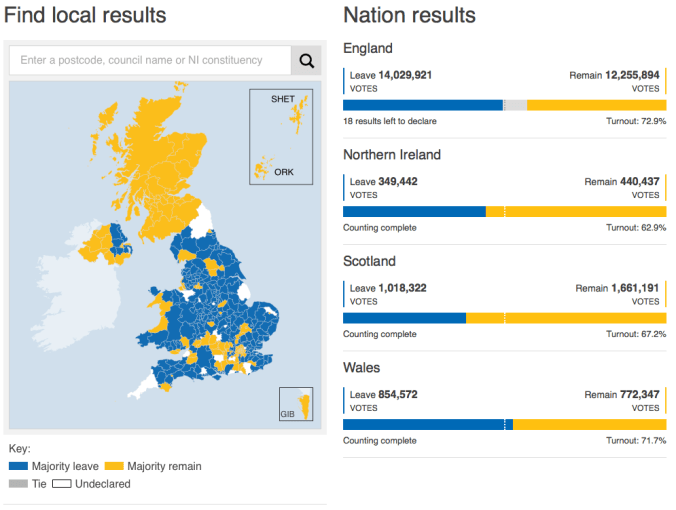
THE United Kingdom has decided. The people in the UK as a whole voted to begin the process of dissolving their political involvement in the European Union. The country has voted to reverse its 1975 decision to join the common market, and leave a unified Europe after 43 years as a member. A vote that some call a vote for independence. But it could spell a whole lot more trouble. By a somewhat narrow margin, the LEAVE campaign won the referendum by a margin of 4 points – 52% to 48%. The decision opens up a lot of room for massive political, economic, and other changes within the UK and Europe as a whole. Some of those ramifications are already being seen.

The British Pound has fallen to levels not seen since the mid-1980s, since Margaret Thatcher was the resident of Number 10 Downing Street. The Euro has fallen more than 3.3% – its biggest one-day drop. Aside from the short term economic impact, the question now turns to negotiations on trade, on tariffs, and other economic details that the country hasn’t had to navigate as a member of the common market.

Screen Shot 2016-06-23 at 11.41.20 PM

The next question is: What does this mean for the United Kingdom itself? Fresh off a recent referendum on Scottish independence, which saw the Scots vote to stay – we now see the divisions clearly. Scotland voted by significant margin to stay in the European Union – 62% to 38% to REMAIN. Scottish leaders say that they see their future in the EU. Will this now be the reason to renew calls for Scottish independence? The counting districts across the whole of Scotland voted to REMAIN. England and Wales, voted to go.

We will see this same question in Northern Ireland as well. For the first time in a long time, there will be a border between Northern Ireland and the Republic of Ireland. Border security becomes a real concern now for the UK government. Does this BREXIT vote stoke renewed calls for unification of the Irish island?

Britain would be the first country to leave the EU since its formation – but a leave vote will not immediately mean Britain ceases to be a member of the 28-nation bloc.

That process could take a minimum of two years, with Leave campaigners suggesting during the referendum campaign that it should not be completed until 2020 – the date of the next scheduled general election.

Once the UK invokes Article 50 of the Lisbon Treaty, it will have up to two years to negotiate its exit. Once that exit is completed, the United Kingdom would not be able to rejoin without the consent of all of the remaining member states. Regardless of the when or how, the task remains the same. How does the government begin to unstitch the nation from 40+ years of European law. What do they keep? What do they let go? What do they need to redo? Will there be more referendums? More elections? New general elections? What does this mean for UK relations with the rest of the world? The United States? Europe? Will this mean that other countries will call for referendums of their own?

If you are a political junkie and nerd like me, this means that you get to see history be made. Regardless, it will certainly be interesting to watch.

More tomorrow on Everyday BRAND.

-A

The Reality of Political Theater

POLITICAL theater and antics is nothing new. With the spread of social media, it is never far from your fingertips. Tonight, Democratic members of the US House of Representatives are participating in an old fashioned sit-in. They claim that the sit-in is in an effort to pressure the Speaker of the House (Republican Paul Ryan) into holding a vote on gun control legislation.

062216_dems_sitin_1280

This action isn’t necessarily unprecedented in the House, but it is extremely rare. But a good question that is lost here, is this necessary? Have the Dems taken action using parliamentary procedure? There are parliamentary ways for the minority to get a vote on a subject. But this? This is a way for them to grab the headlines. The Dems have been doing just that for more than 12 hours (at the time of this writing). The sit-in is led by venerable civil rights icon, Congressman John Lewis. The action on the floor of the House is tapping in to the sentiment following the deadliest mass shooting in modern US History at Pulse nightclub in Orlando. The massacre rekindled the debate over gun control measures in this country. All of this theatrics, appears to be for naught. As with most of the “work” Congress needs to do, this is likely going nowhere. This even as a CNN/ORC poll shows that nearly 90% of the public supports some tightening of regulations and measures on gun control.

It is a difficult battle to fight. One side paints this as a quintessential American right, and the other paints this as an outrageous interpretation of a centuries old document. To be honest, what are we all fighting about? Yes, the assertion that no matter what law you pass, what regulation you make, it is only the law abiding citizens that will be affected. Criminals will always find ways to circumvent those laws. That’s what makes them criminals. But does that mean we should do nothing? Leave it as the status quo?

US-Capitol-Building1

 Clearly the status quo isn’t working. We continue to send thoughts and prayers out to our fellow Americans and people around the world time and time again. But what is the answer? I won’t pretend that I have that answer. But what I will say, is that the start of that answer is civil discourse and compromise. We won’t ever be perfect. We won’t ever be right 100% of the time. That would be boring, and what would be the point? What I will say about the state of our Congress is that it is far from common sense and civil. If Congress worked and did things like they were supposed to, this sit-in would never happen. A group of members wouldn’t feel the need to stage a massive theatrical production to rival the new Broadway hit. That is what needs to change first, but sadly the American voter won’t let that happen.

The sit-in is not just an example of the failure of our governing bodies, but it is an example of the failure of the American voter. The fact that participation in American elections is consistently low is another factor. But voters in this country find words like compromise and bipartisanship to be dirty curse words these days. If a Republican member decided to try and work with a Democrat to get some common sense legislation done, they’d have a well funded primary challenger within weeks. That is the unfortunate thing and what we see on the Hill is a direct result of this. What party officials, some politicians, political activists and voters don’t seem to always understand is that there is a difference between campaigning and governing. So the gun control debate is a symptom of the larger problem. We seem to be losing the common sense voices in this process. There doesn’t seem to be a desire to find common ground. There seems to only be the desire to win and win bigger than the last time. Until we fix that, the status quo will continue to affect us all.

More tomorrow on Everyday BRAND.

-A

Hillary Makes History, Bernie goes for Bust.

BBsQgnZ.imgBy now, the dust has settled from the last major primary day on the calendar. The two major parties have their presumptive nominees. These nominees of course will not be official until their respective nominating conventions at the end of July. The Republicans will meet in Cleveland and nominate (barring any oddities) real estate mogul and reality television star, Donald Trump (the equivalent to the GOP’s Kim Kardashian). The Democratic Party is poised to make history and officially nominate Hillary Clinton who is the first woman to ever clinch a major party’s nomination for President of the United States. Regardless of where you stand on the political spectrum, this is a significant historical moment.

And then. There’s Bernie. The lovable old curmudgeon of a Senator from the State of Vermont. Again, despite my personal politics or yours, Bernie Sanders definitely made this race interesting and changed the game in politics in this cycle. The size of his rallies and his team’s seemingly great ground game were a sight to see. History will determine how well they were in really mobilizing arenas of people to the polls, but sadly for him, this race is all but over. However, he is vowing to fight until the convention in Philadelphia. The why? Because revolutions don’t generally succumb to a gracious defeat.

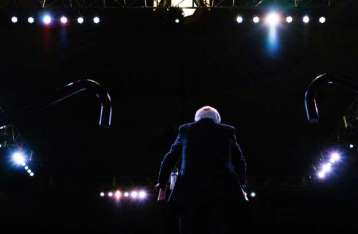
On Tuesday, Bernie spoke in Santa Monica. The day prior, the media crowned Hillary Clinton with the title of PRESUMPTIVE NOMINEE. Bernie banked his late game on California, and the results were a final crushing blow to an already mathematically eliminated campaign. In his speech (which could be called anything but conciliatory), he struck a stubborn tone, ignoring a history-making night for what should be a somewhat friendly rival. When he mentioned her, in passing, the large crowd in an airport hangar booed loudly, and the vanquished candidate did little to dissuade the response. Continue reading